
Exploring protection opportunities in the Tū Łī́dlini (Ross River) area
Ross River Dena Council, the Government of Yukon and Parks Canada agreed to explore options for protection and conversation in the Tū Łī́dlini (Ross River) area. They struck a steering committee who is conducting a feasibility assessment within an identified study area.
No decisions have been made about creating a new park or protected area. Existing authorized land access, tenure, rights and uses are not affected.
On December 4, 2024, Ross River Dena Council, the Government of Yukon and Parks Canada signed a Memorandum of Understanding to assess the suitability and feasibility of protecting land within the Tū Łī́dlini (Ross River) area.
The Memorandum of Understanding:
Does not impact existing land access, tenure, rights or uses already authorized or permitted in the area.
Does not create a new park.
Does not make a decision about creating new parks or protected areas in the study area.
Identifies a study area within the Tū Łī́dlini (Ross River) area in which a feasibility assessment of possible future land protections will occur.
Details a path forward to hear from the public.
Establishes a steering committee with representatives from Ross River Dena Council, the Government of Yukon and Parks Canada
Ross River Dena Council, the Government of Yukon and Parks Canada are working together to study options for potential new protected area within the study area.
A steering committee is doing a feasibility study of the study area. They will identify whether 1 or more areas within the study area may be appropriate for protection and under what conditions. They will assess these potential areas while considering existing land uses and social, environmental, cultural and economic interests and other values in the study area.
This initiative is a collaborative undertaking by Ross River Dena Council, the Government of Yukon and Parks Canada.
Status of the feasibility study
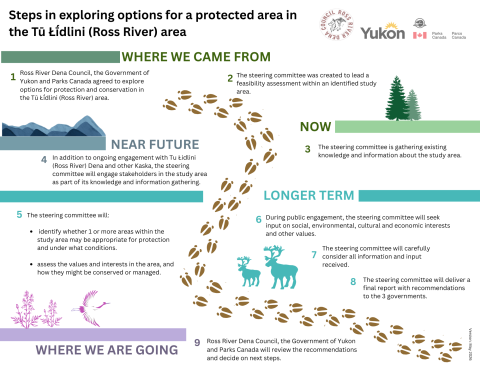
The steering committee has developed a process for undertaking the feasibility study.
The steering committee is gathering knowledge and information about the study area.
No decisions have been made at this time about creating any new parks or protected areas in the study area.
Current activities in the study area can continue in accordance with the terms of any required authorizations:
- hunting;
- outfitting;
- tourism;
- trapping; and
- mining.
Download the Steps in exploring options for a protected area in the Tū Łī́dlini (Ross River) area.
Learn more at Tū Łī́dlini (Ross River) area: Exploring the potential for a new protected area.
Purpose of the feasibility study
The 3 governments support Indigenous leadership in conservation and aim to protect areas of ecological and cultural importance in the Yukon.
The study area:
- holds cultural and spiritual significance to the Tū Łī́dlini Dena, including sacred, cultural and historical sites; and
- contains diverse ecosystems and migration corridors with habitat for at-risk species.
Working together, we are exploring innovative stewardship that balance environmental conservation, cultural preservation and economic opportunity.
The feasibility study is a multi-step process to help the 3 governments decide whether protecting portions of the Tū Łī́dlini (Ross River) area is feasible and desirable. It will also ensure existing land uses and environmental, cultural and economic interests are considered.
The feasibility assessment process is different from other processes that are familiar in the Yukon, like land use planning established through the Umbrella Final Agreement and Yukon First Nations Final Agreements. This is because the Ross River Dena Council has not signed a treaty agreement with the governments of Yukon and Canada. The Tū Łī́dlini Dena are part of the Kaska Dena Nation and have constitutionally protected rights like all Yukon First Nations Peoples. Kaska Dena have not ceded or surrendered Aboriginal rights and title.
This initiative is a chance to explore new land use approaches in areas without Final Agreements, which may provide more certainty for all with interests in these areas.
The steering committee's role
The steering committee will:
- identify areas within the study area that may be appropriate for protection;
- identify legal protection tools that could be used to establish a protected area;
- gather information and feedback through a public engagement process;
- carefully consider existing land uses, tenures, rights and interests in the study area;
- assess potential social, environmental, cultural and economic opportunities and challenges within the study area.
The steering committee will provide a report with recommendations to the 3 governments on:
- whether it is feasible, practical and desirable to create on 1 or more protected areas in the study area and under what conditions;
- locations within the study area that may be suitable for protection; and
- legal tools that could be used to establish a protected area.
Once the feasibility study is complete, the 3 governments will decide on next steps.
Steering committee members
As per the Memorandum of Understanding, the steering committee will be made up of representatives of each government:
- Parks Canada: 1 representative.
- Government of Yukon: 1 representative.
- Ross River Dena Council: 2 representatives.
Give feedback
The steering committee will gather information and feedback through a public engagement later in the feasibility study process.
When the public engagement begins, details on how to participate will be posted online at Tū Łī́dlini (Ross River) area: Exploring the potential for a new protected area.
Everyone is encouraged to participate in the steering committee’s public engagement process, including:
- First Nations governments;
- local communities;
- industry stakeholders; and
- the general public.
This will help the steering committee identify and consider the social, environmental, cultural and economic interests and other values in the study area.
The information and feedback received during the public engagement process will inform and guide the steering committee’s report and recommendations to the 3 governments.
The Government of Yukon will consider the information and feedback in its decision-making along with the other 2 governments.
Study area interests and activities
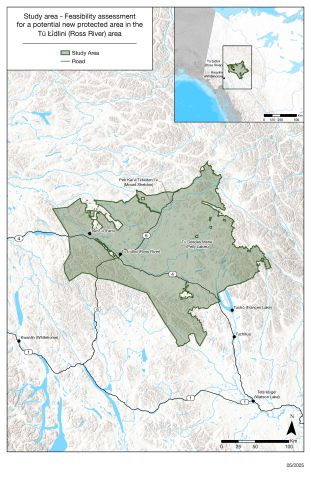
The study area is located within the Tū Łī́dlini (Ross River) area.
The study area spans approximately 39,300 square kilometres. It does not include:
- areas that overlap the Traditional Territories of Yukon First Nations with Final Agreements; and
- areas with existing Class 3 and 4 quartz mining approvals as of the December 4, 2024 signing date of the Memorandum of Understanding.
The study area supports many land uses, including:
- hunting;
- outfitting;
- tourism;
- trapping; and
- mining exploration; and
- mining development.
Current activities within the study area can continue in accordance with the terms of any required authorizations. This includes:
- hunting;
- outfitting;
- tourism;
- trapping; and
- mining.
Mineral exploration and development
There is no prohibition on any existing activities including the issuance of new authorizations on existing mineral claims.
- Claim holders (quartz and placer) can work on their existing claims subject to approvals.
- Lower-level exploration activities require a Class 1 notification before working the claims.
- Operators (quartz and placer) must apply and receive government approval and authorization to do more advanced mineral exploration and development on their claims (known as Class 3 or 4 mining land use approvals).
- Projects with existing Class 3 and 4 quartz mining land use authorizations prior to the December 4, 2024 signing date of Memorandum of Understanding are not included in the study area.
- Projects with a Class 1 notification on the December 4, 2024 signing date of Memorandum of Understanding are included in the study area. A Class 1 project that receives a Class 3 or 4 quartz approval will remain in the study area.
Claim holders can contact the Watson Lake Mining Recorder's Office with any questions.
New claims in the study area?
No new claims can be staked in the area.
The Government of Yukon has maintained a prohibition order preventing staking of new mineral claims within the asserted traditional territory of the Kaska Nation in the Yukon since 2013.
This mineral staking prohibition order is currently in effect until April 30, 2028.
Impacts on existing interests within the study area
The feasibility study and the steering committee’s activities do not affect existing land access, tenure, rights or uses already authorized or permitted in the area.
We are committed to a transparent and inclusive decision-making process that considers the needs and concerns of all stakeholders.
Everyone is encouraged to participate in the steering committee’s public engagement process.
The information and feedback provided will help shape the steering committee's feasibility study and recommendations.
The Government of Yukon will consider the information and feedback in its decision-making.
Decision making
The Memorandum of Understanding does not create a park.
The study area is not a proposed boundary for a protected area or a park.
The steering committee may identify 1 or more areas within the study area that are appropriate and feasible for protection.
The steering committee will identify and review the legal protection tools that could be used to establish a protected area, such as a national or territorial park or other options.
No decisions have been made at this time about creating any new parks or protected areas in the study area.
Once the feasibility study is complete, the 3 governments will each review the steering committee’s report and recommendations and decide on next steps.
Contact information
For questions email the Steering Committee at [email protected].