
This is a joint news release between the Government of Yukon, the United States National Park Service and Alaska Wildlife Troopers.
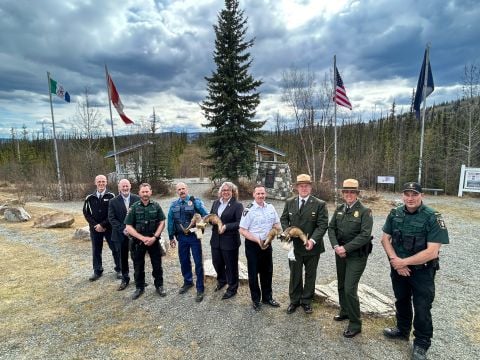
Two thinhorn sheep illegally harvested in a cross-border poaching case were returned to the Yukon during a May 12 to 13 meeting of enforcement officials from the Yukon and Alaska, reaffirming the territory’s ongoing partnership and collaboration in wildlife protection.
Government of Yukon Conservation Officer Services, Alaska Wildlife Troopers and United States National Park Service worked together on the investigation, with support from Environment and Climate Change Canada, resulting in convictions in the Yukon and Alaska and more than $100,000 CAD in combined fines.
The significant outcome of this case underscores the serious consequences of illegal cross-border activity and sets a strong precedent for higher penalties against those who violate wildlife laws.
The case also highlights the effective ongoing relationship between Yukon and U.S. enforcement agencies and the importance of working together to protect wildlife across the vast northern landscape.
In December 2024, three individuals pleaded guilty in the Yukon’s Territorial Court to the unlawful harvest of two thinhorn sheep rams. The individuals were sentenced to:
- a fine of $10,000 CAD each, to be paid to the Turn in Poachers and Polluters (TIPP) Fund;
- a five-year hunting prohibition to remain in place for five years or until the fines are paid in full, which has since occurred; and
- forfeiture of all items seized.
Two of the individuals also pleaded guilty to wasting meat from the illegally harvested sheep and were fined $3,500 to be paid to the TIPP Fund each.
Related charges were brought against the same three individuals in the United States District Court for the District of Alaska in 2025. The individuals pleaded guilty to two of the charges and were each put on probation for five years and fined $5,000 USD. Their firearms and the sheep, including trophies, were ordered to be forfeited and the individuals were also ordered to collectively pay $58,200 USD in restitution to the Government of Yukon, which has been paid in full.
The returned thinhorn sheep horns were forfeited to the Government of Yukon. One will be retained for educational purposes and the other has been donated to the National Park Service. Capes will be sold at auction to fund conservation initiatives. The meat was donated to the White River First Nation.
This case highlights our strong cross-border partnership in managing our shared wildlife resources. This outcome reflects how the partnership between Yukon Conservation Officer Services and U.S. enforcement agencies supports responsible stewardship and upholding wildlife laws through mutual commitment.
Protecting wildlife resources requires cooperation that extends beyond geographic boundaries. The National Park Service values its partnership with Yukon and Alaska enforcement agencies and remains committed to supporting collaborative efforts that uphold wildlife laws and conserve these resources for future generations.
This case demonstrates that wildlife crimes do not stop at international borders and neither does our commitment to protecting Alaska's wildlife resources.
The successful outcome of this investigation reflects the strong and long-standing partnerships between Yukon Conservation Officer Services, Alaska Wildlife Troopers, the National Park Service and our other law enforcement partners. By working together, we were able to hold those responsible accountable and help ensure that our regional wildlife resources remain protected for future generations.
-
In August 2022, Yukon Conservation Officer Services partnered with United States National Parks Service and Alaska State Wildlife Troopers in a joint operation to patrol the border and monitor for illegal cross-border hunting activities.
-
This work resulted in the identification and subsequent prosecution of three American hunters who harvested two rams between White River and Beaver Creek in the Yukon and reported these harvests as having occurred in Alaska.
-
The case saw an outcome in the Territorial Court of Yukon in December 2024, and March 2025 in United States District Court for the District of Alaska.
-
The investigation into this case required the coordinated efforts of Government of Yukon Conservation Officer Services, United States National Park Service, Alaska State Troopers, Environment and Climate Change Canada and Parks Canada.
-
The return of the thinhorn sheep to the Yukon took place in May 2026, as U.S. authorities were required to hold the items as evidence until all legal processes, including mandatory evidence retention periods, were complete.
-
In the Yukon, concerns about wildlife and all Wildlife Act and Environment Act violations, can be reported confidentially at any time to the 24-hour TIPP line at 1-800-661-0525 or through Yukon.ca/TIPP.
Matt Davidson
Director, Cabinet Communications
867-334-6637
[email protected]
Linea Volkering
Communications, Environment
867-332-2688
[email protected]
National Park Service
Office of Communications
[email protected]
Austin McDaniel
Communications, Alaska Department of Public Safety
907-269-5413
[email protected]